【Black Myth】Shanxi-Changzhi
14-Day Black Myth: Wukong Shanxi Pilgrimage: The Real Kingdoms of the Destined One
Designed for American Travelers · 5-Star & Boutique Heritage Hotels · Private Transportation & High-Speed Rail · All Temple Admissions Included · Dedicated English-Speaking Guide
Step through the screen into the living world of Black Myth: Wukong. Of the game's three dozen real-world scanning locations, 27 are in one province — Shanxi, the extraordinary open-air museum of Chinese architecture. This is the definitive north-to-south pilgrimage: stand before the colossal Buddhas of Yungang, climb the cliff-pinned Hanging Temple, gaze up at the world's oldest wooden pagoda, find rare Tang-dynasty halls lost for a thousand years, wander the living Ming city of Pingyao, and enter the gilded suspended-sculpture heaven that inspired the game's most famous scene. Privately guided, thoughtfully paced, no shopping stops — a journey from the Northern Wei dynasty all the way to the mythic West.
Tour Highlights
- The Complete Wukong Route in One Journey — All 8 Shanxi Cities Datong, Shuozhou, Xinzhou, Jinzhong (Pingyao), Linfen, Changzhi, Jincheng and Yuncheng, linked by private car and China's sleek high-speed rail.
- Two Anchor UNESCO World Heritage Sites, Plus Sacred Mount Wutai The Yungang Grottoes (2001), with 59,000 carved statues, and the Ancient City of Pingyao (1997), including the outlying treasure temples Shuanglin and Zhenguo. Day 6 also visits Mount Wutai (2009), one of China's four sacred Buddhist mountains.
- The Scene Everyone RemembersXiaoxitian ("Little Western Heaven"), whose entire hall dissolves into a breathtaking suspended cosmos of gilded sculpture — the setting of the famous line, "You see the Future; why not bow?"
- The Game's Opening Deities The astonishing 28 Mansions painted sculptures of Jincheng's Yuhuang Temple, and the fierce, otherworldly figures of Gaoping's Tiefo Temple.
- Architecture You Cannot See Anywhere Else The 1,500-year-old cliffside Hanging Temple; the nail-free 1056 AD Yingxian Wooden Pagoda; and the Tang-dynasty Foguang and Nanchan Temples that rewrote art history.
- A Scholar's Pilgrimage, Made Effortless We secure every hard-to-get timed ticket, route the long drives around the mountains, and bring the gilded figures and Buddhist cosmology to life with expert guiding.
Day-by-Day Itinerary
Day 1 | Arrival in Datong — The Ancient Capital Aglow
- Meals: Dinner
- Overnight: Datong, boutique hotel inside the ancient city
Arrive at Datong Yungang Airport or by high-speed rail; private transfer to the hotel inside the old city.
- Welcome to Datong, capital of the Northern Wei dynasty and the gateway to your pilgrimage. Settle into a comfortable hotel within the restored ancient city, then take an easy evening walk along the magnificent city walls, illuminated at sunset.
- Pass the dramatic Nine-Dragon Wall — older and larger than the famous one in Beijing — and watch lanterns come on across tiled rooftops.
- Welcome dinner: Northern Shanxi cuisine, including hand-shaved knife-cut noodles (daoxiao mian), savory braised dishes and local millet wine.
Day 2 | Yungang Grottoes — An Entire Mountain Carved into Buddhas
- Meals: Breakfast, Lunch
- Overnight: Datong
Full day; approx. 40-minute transfer each way.
- Morning: Devote the morning to the Yungang Grottoes, a UNESCO World Heritage Site (2001) and the masterpiece of 5th-century Chinese Buddhist art. Carved into a sandstone cliff for nearly a kilometer, its 252 caves hold more than 59,000 statues — from finger-sized figures to the towering open-air seated Buddha of Cave 20, whose serene smile has greeted visitors for 1,500 years. Trace the elaborate painted Caves 5 and 6, the grand royal caves, and the weathered later grottoes where Indian, Central Asian and Chinese styles converge.
- Afternoon: Visit the excellent Datong Museum to understand the Northern Wei capital behind these statues, then return to the city for two great Liao/Jin temples within the walls:
- Huayan Temple, home to China's largest Liao dynasty hall and the exquisite "Heavenly Palace" sutra cabinets;
- Shanhua Temple, the most complete Liao/Jin temple layout in China, whose Four Heavenly Kings inspired in-game imagery.
Day 3 | Hunyuan — The Hanging Temple & the Yuan Masterpiece
- Meals: Breakfast, Lunch
- Overnight: Hunyuan, heritage inn
Approx. 1–1.5-hour drive Datong → Hunyuan (about 80 km).
- Morning: Drive south into the Hengshan mountains to the astonishing Hanging Temple, pinned to a sheer cliff 50–60 meters above the gorge for over 1,500 years. With your pre-arranged climbing ticket (numbers are strictly capped), ascend the narrow wooden walkways and enter China's only temple where Buddhism, Taoism and Confucianism coexist in a single hall — an engineering marvel of beams inserted deep into the rock. The slender poles beneath are mostly for reassurance; the real support hides within the mountain.
- Afternoon: Enter the old garrison town to visit Yongan Temple, whose vast Yuan-dynasty hall holds one of China's greatest water-and-land (shuilu) mural cycles — nearly 900 figures of all three teachings across the walls. Explore the "turtle city" lanes and the remarkable iron phoenix weather vane atop the Yuanjue Temple brick pagoda. Try the famous cool, springy Hunyuan jelly noodles.
Day 4 | Yingxian Wooden Pagoda & Shuozhou — Onward to the Heart of Shanxi
- Meals: Breakfast, Lunch
- Overnight: Taiyuan, 5-star business hotel
Hunyuan → Yingxian approx. 45 minutes; Yingxian → Shuozhou approx. 1 hour; high-speed rail/transfer south toward Taiyuan.
- Morning: Stand beneath the Yingxian Wooden Pagoda (Sakyamuni Pagoda of Fogong Temple), built in 1056 AD and still the oldest and tallest pure-wooden pagoda on earth. At 67 meters, its five stories and six tiers of eaves use not a single nail — only hundreds of interlocking dougong bracket sets, a veritable "museum of brackets" that have flexed through centuries of earthquakes. Climbing inside is no longer permitted to protect the structure, but the ground-floor timber grandeur and surrounding Liao statuary are unforgettable.
- Continue to Shuozhou and the great Chongfu Temple, one of China's three major Liao/Jin Buddhist temples. Its Amitabha Hall preserves a celebrated set of "five wonders," including the finest surviving Jin-dynasty carved lattice windows, a colossal 14-meter Buddhist backdrop, and 327 square meters of Jin frescoes.
- Evening: Transfer to the high-speed line for the ride south to Taiyuan, the modern provincial capital, for a relaxed dinner of Shanxi's vinegar-rich cuisine and aged hand-pulled noodles.
Day 5 | Foguang & Nanchan — The Tang Treasures Lost for a Thousand Years
- Meals: Breakfast, Lunch
- Overnight: Wutai / Taihuai area, mountain hotel
Approx. 2–2.5-hour drive Taiyuan into the Wutai hills; both temples visited in one day.
- Journey into remote valleys southwest of the sacred mountain to find two of China's rarest buildings.
- Nanchan Temple, rebuilt in 782 AD, is the oldest surviving wooden building in the country; its small, perfect hall houses a rare set of Tang painted sculptures.
- A short drive away, the grand Foguang Temple ("Temple of Buddha's Light") holds the majestic East Hall of 857 AD — "China's No. 1 National Treasure," as Liang Sicheng called it when he and Lin Huiyin rediscovered it in 1937, disproving the claim that no Tang wooden halls survived.
- The East Hall unites four arts in one place: monumental Tang architecture, life-sized Tang sculptures, contemporary murals, and the inked donor inscriptions that dated the building. Walk the quiet courtyards among ancient pines and feel the serene confidence of High Tang design.
Day 6 | Mount Wutai — Bodhisattva of Wisdom, Then South to Pingyao
- Meals: Breakfast, Lunch
- Overnight: Pingyao, traditional courtyard boutique inn
Morning in the Mount Wutai monastic center; afternoon high-speed rail/transfer to Pingyao.
- Morning: Spend time in the living heart of Mount Wutai, a UNESCO World Heritage Site (2009), seat of Manjusri, Bodhisattva of Wisdom, and one of China's four sacred Buddhist mountains. Stroll the great temples clustered around Taihuai — the towering white pagoda, the incense-filled Xiantong Temple, and monks in crimson robes performing morning rites among incense smoke and pine-scented air. Foguang and Nanchan, visited yesterday, are ancient outer-area temples and not part of this specific World Heritage inscription.
- Afternoon: After lunch, transfer to the high-speed line and ride south across the Shanxi plateau to Pingyao, checking into a beautifully converted courtyard residence inside the ancient city.
Day 7 | Pingyao Ancient City — China's Walled Merchant Capital
- Meals: Breakfast, Lunch
- Overnight: Pingyao
Full day on foot within the old city.
- Spend a full day inside the Ancient City of Pingyao, a UNESCO World Heritage Site (1997), the finest preserved walled county seat in China and the 19th-century financial center of the entire country.
- Walk or cycle the lantern-lit lanes between high grey-brick walls; visit Rishengchang, the "draft bank" that pioneered China's first remittance system and grew into a nationwide financial empire; the old County Government Office with its halls and courtyards; the City God Temple; and the ancient Confucian precincts.
- Climb the 6-kilometer Ming city wall at golden hour as tiled rooftops stretch to the hills.
- Dinner: A Shanxi merchant-style banquet — Pingyao beef, oat-flour noodles, handmade cat-ear pasta and aged Shanxi vinegar — in a lantern-hung courtyard.
Day 8 | Shuanglin & Zhenguo — The Sculpture Treasure Temples; Rail to Linfen
- Meals: Breakfast, Lunch
- Overnight: Linfen, 5-star business hotel
Shuanglin approx. 6 km southwest; Zhenguo approx. 12–15 km northeast; afternoon high-speed rail Pingyao → Linfen (~1 hour).
- Morning: Visit Pingyao's two outlying World Heritage temples.
- Shuanglin Temple is an "Eastern treasure house of painted sculpture": more than 2,000 clay figures populate its halls, from serene Buddhas and fluid guardian warriors to vivid attendants — a pinnacle of Chinese sculptural art.
- Across the plain, smaller Zhenguo Temple preserves the rare Ten-Thousand Buddha Hall of 963 AD, one of China's oldest wooden buildings, with precious Five Dynasties painted sculptures.
- Afternoon: After lunch, board the high-speed train to Linfen, ancient heartland of Yellow River civilization. Check in and enjoy an easy evening along the Fen River; dinner may feature the region's famous steamed dishes and local lamb.
Day 9 | Guangsheng Temple & Xiaoxitian — The Suspended Buddhist Universe
- Meals: Breakfast, Lunch
- Overnight: Xi County, best available local hotel
Linfen → Hongtong (Guangsheng) approx. 40 minutes; Hongtong → Xi County (Xiaoxitian) approx. 1.5–2 hours. Long but rewarding day.
- Morning: Begin at Guangsheng Temple on the slopes of Hongtong, a complex founded in the Han dynasty. Climb to the Upper Temple and the dazzling Feihong ("Flying Rainbow") Pagoda, China's tallest all-glazed pagoda, shimmering in emerald, amber and cobalt. The Lower Temple once held rare Yuan-dynasty Water God Temple murals and the celebrated Zhaocheng Jin Canon, one of China's greatest Buddhist scriptures.
- Afternoon: Drive west into the loess hills to the day's crown: Xiaoxitian — "Little Western Heaven" — in Xi County. Founded in 1629, its modest Grand Hall opens onto one of the most extraordinary interiors in China: over 1,900 gilded sculptures suspended across walls, beams and rafters in 33 layers of celestial palaces, clouds, heavenly musicians and Buddhist paradises — a breathtaking "suspended sculpture swan song" and the unmistakable inspiration for the game's "You see the Future; why not bow?" Around midday, sunlight can catch the gilded figures so they seem to glow. Visit slowly; this is a masterpiece.
Day 10 | Across to Changzhi — Guanyin Hall & the Song Sculptures
- Meals: Breakfast, Lunch
- Overnight: Changzhi, business hotel
Xi County → Changzhi approx. 2.5–3 hours crossing the Taihang foothills; afternoon in Changzhi.
- Drive east across the grain of the mountains into southeastern Shanxi, the region of the most refined Song and Ming temple sculpture.
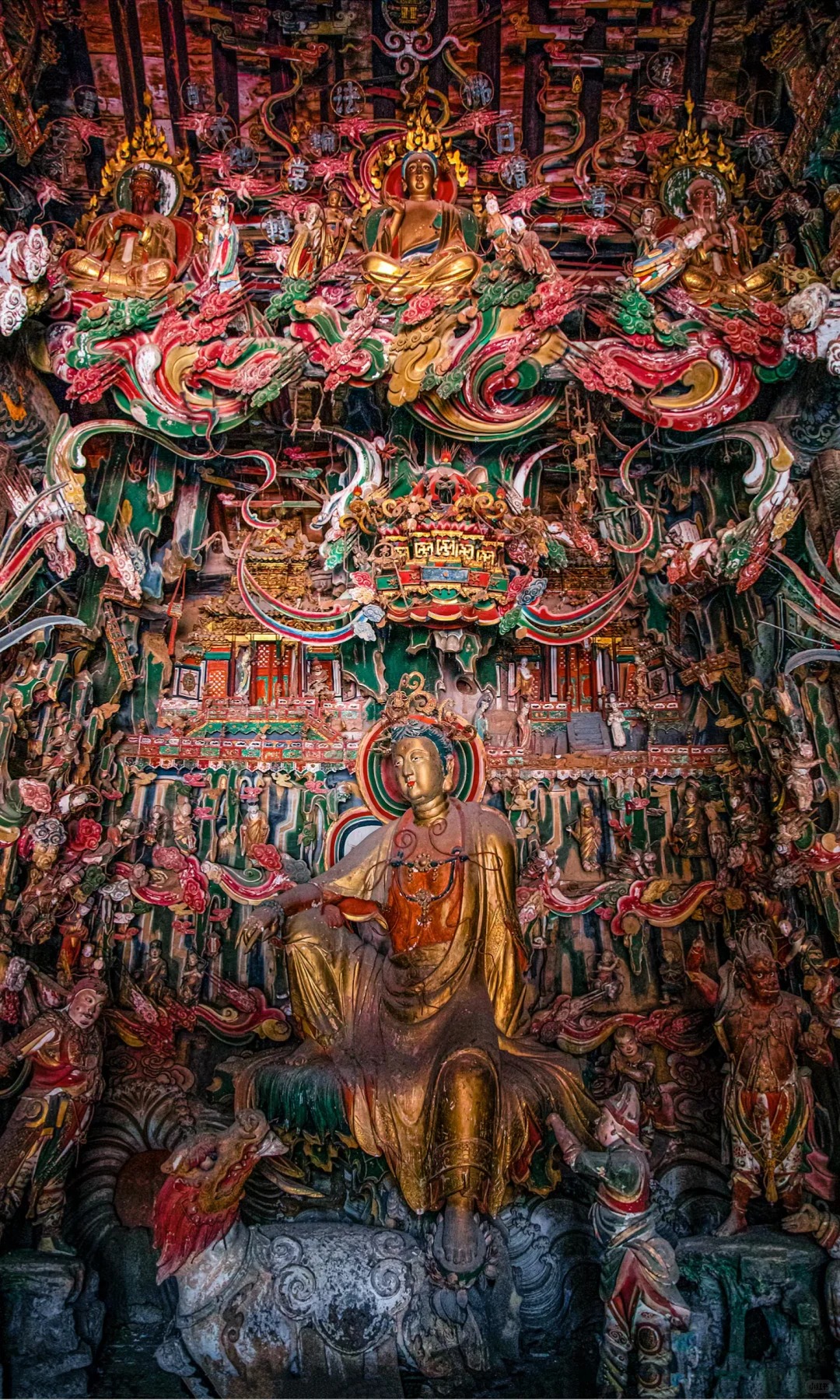
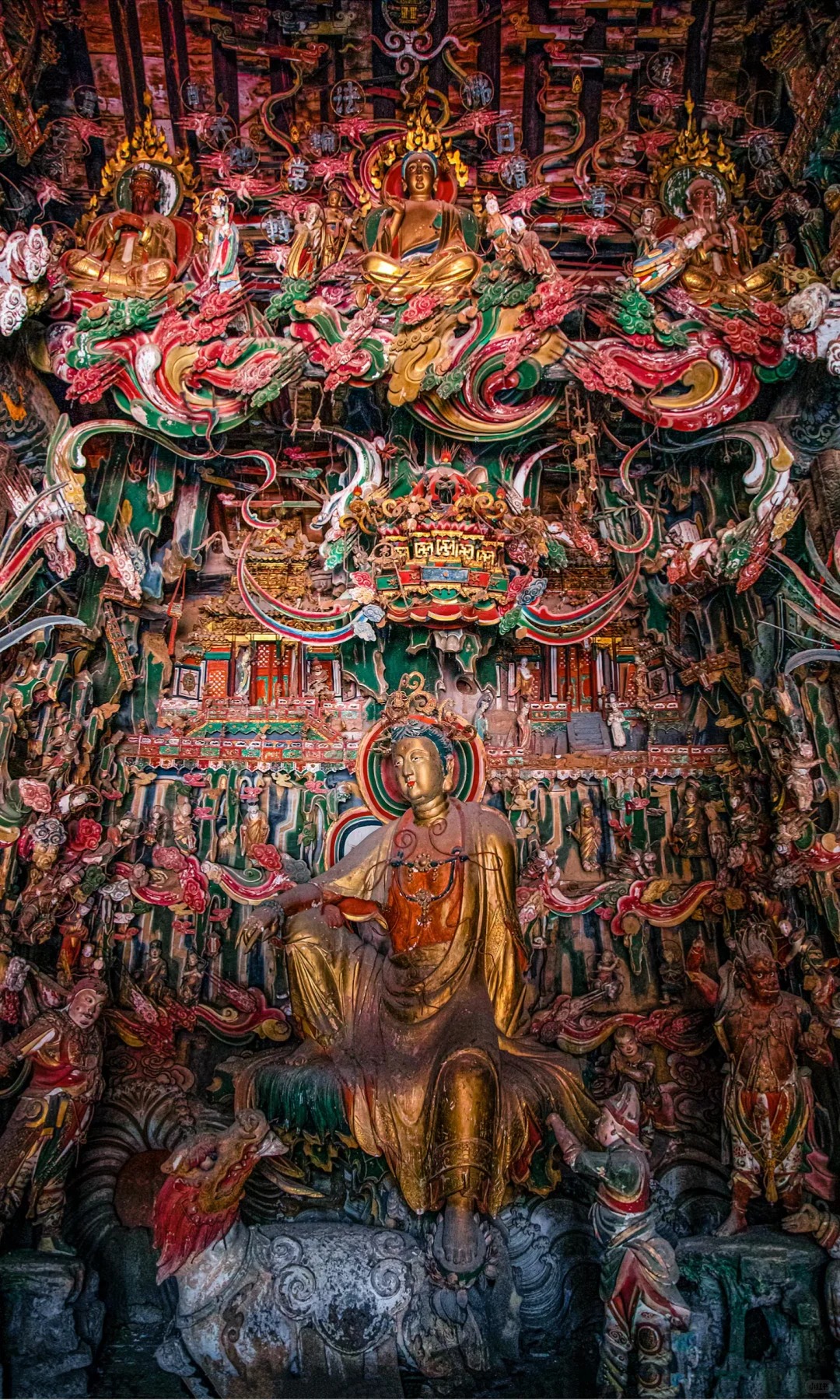
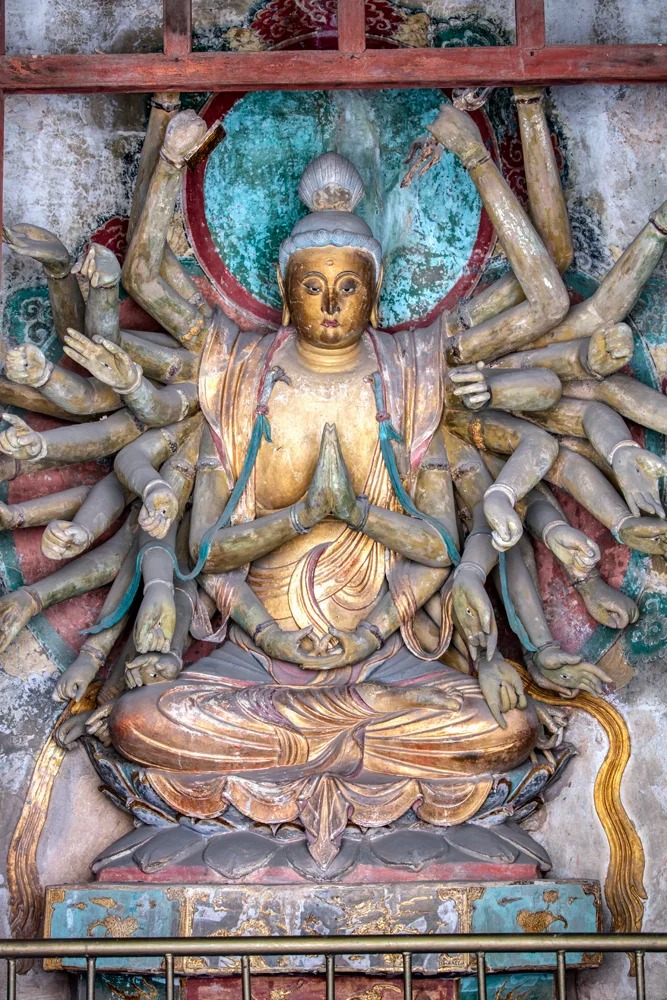
- In Changzhi, visit the intimate Guanyin Hall, whose interior is filled floor-to-rafter with a dense, animated host of Ming-dynasty painted figures — Buddhas, arhats, guardians and attendants layered among painted landscape and heavenly architecture.
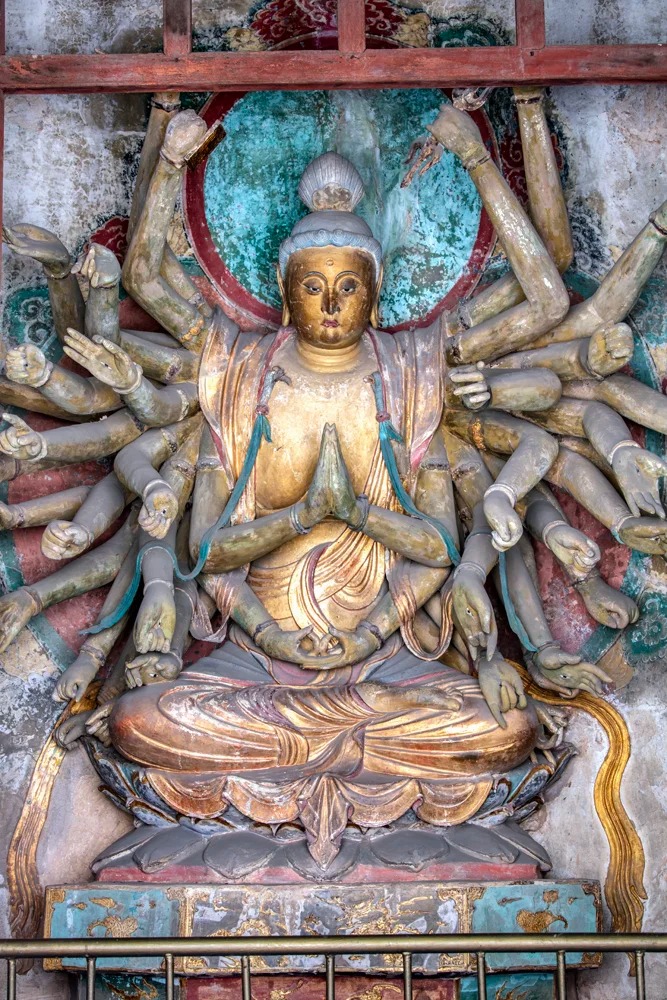
- Nearby, the sculptures of Chongqing Temple rank among the finest Song-dynasty clay work in the country, with expressive arhats and serene bodhisattvas.
- Evening: Check into Changzhi and taste southeastern Shanxi specialties, including hearty stews and delicate wheat preparations.
Day 11 | Gaoping Tiefo Temple & Jincheng Yuhuang Temple — The 28 Mansions
- Meals: Breakfast, Lunch
- Overnight: Jincheng, business hotel
Changzhi → Gaoping approx. 50 minutes; Gaoping → Jincheng approx. 40 minutes.
- Today meet two of the game's most direct sculptural sources.
- In Gaoping, the small Tiefo ("Iron Buddha") Temple houses a startling, almost overwhelming Ming-dynasty assembly of life-sized painted sculptures — vivid, muscular, fiercely expressive figures unlike anything in ordinary temples. The horse-spirit's mask in the game draws directly on one of these guardian generals. Entry is limited and timed; visits depend on availability and are booked well ahead.
- Continue to Jincheng and the renowned Yuhuang (Jade Emperor) Temple in Fucheng. Its rear hall enshrines the famous 28 Mansions — Taoist stellar deities as human figures, each about 1.8 meters tall, each accompanied by its own symbolic animal. These Yuan-dynasty masterpieces, including the figure that inspired the game's Transform stone "Room Fire Pig," are among the most characterful in all Chinese religious art.
Day 12 | Onward to Yuncheng — Guandi Temple of the God of War
- Meals: Breakfast, Lunch
- Overnight: Yuncheng, business hotel
Jincheng → Yuncheng approx. 2 hours by road/high-speed rail; Xiezhou Guandi Temple approx. 30 minutes from the city.
- Travel to the far south, where Shanxi meets the great bend of the Yellow River — the homeland of Guan Yu.
- At Xiezhou, visit the Guandi Temple, the oldest, largest and most authentic temple to Guan Yu (Lord Guan), the deified Three Kingdoms general revered as God of War, God of Wealth and patron of loyalty. The sprawling complex of halls, archways and ancient cypresses inspired the game's Guan-related architecture and iconography.
- Check into Yuncheng and enjoy an easy evening; the region is famed for flour-based dishes and Yellow River fruits. Travelers short on time may depart from Yuncheng this evening, but we recommend the next two days for the Yongle and Yongji masterpieces.
Day 13 | Yongle Palace — The Greatest Taoist Murals in China
- Meals: Breakfast, Lunch, Dinner
- Overnight: Yuncheng
Yuncheng → Ruicheng approx. 1.5–2 hours; full day along the Yellow River.
- Drive west along the Yellow River to Yongle Palace in Ruicheng, the 13th-century Taoist temple of the immortal Lü Dongbin and home to what many consider the finest Taoist murals ever painted.
- In the Hall of the Three Pure Ones, the monumental Assembly of the Deities unfolds across the walls in a grand procession of 286 divine beings — celestial emperors, jade maidens and heavenly generals — drawn with flowing, near-musical linework and luminous mineral color that deeply inspired the game's aesthetic. The entire temple was moved, stone by stone and panel by panel, in a legendary 1950s relocation to save it from a reservoir.
- In Ruicheng you may also see the humble Tang-dynasty Guangrenwang Temple hall (831 AD), one of the few surviving Tang wooden buildings.
- Return to Yuncheng for the farewell dinner.
Day 14 | Departure — The Pilgrimage Complete
- Meals: Breakfast
Morning at leisure; transfer to Yuncheng Zhangxiao Airport or high-speed rail.
- Enjoy a final leisurely breakfast and a short walk in the morning light. Your driver transfers you to Yuncheng Zhangxiao Airport or the high-speed rail station for your onward journey — to Xi'an (about 1–1.5 hours by train, an excellent extension), or home.
- Guests with an extra day can take the Yongji corridor: the storied Guanque Tower of Tang poetry and the ancient Qiufeng Tower, or the elegant Feiyun Pavilion at Wanrong — completing the southernmost Wukong locations.
Fourteen days, eight cities, multiple World Heritage treasures and 1,500 years of timber, clay and gold — you will leave Shanxi seeing the game, and perhaps all of Chinese art, with entirely new eyes.
What's Included
- Accommodation: 13 nights in 5-star, boutique and heritage courtyard hotels as listed (daily breakfast); the best available comfortable hotel in smaller towns such as Xi County
- All private transportation: Airport and rail transfers, intercity private vehicle with experienced driver, and high-speed rail tickets (second class; business class available) for the long transfers, including Pingyao → Linfen
- A dedicated, knowledgeable English-speaking guide throughout, with specialist art-history guiding at the sculpture temples
- All temple, grotto and museum admissions listed in the itinerary, including the hard-to-secure Hanging Temple climbing ticket, Xiaoxitian, Yungang, Pingyao and its outlying temples, Yuhuang Temple and Yongle Palace
- Meals as listed (B/L/D): Welcome and farewell dinners, daily lunches and local specialties; drinking water and tea included
- Porterage, government taxes and service charges
- No shopping stops, ever
What to Know
- The 27-location list by city: Black Myth: Wukong scanned 27 Shanxi sites. This itinerary covers the essential ones and offers the remainder as optional add-ons:
- Datong: Yungang Grottoes, Hanging Temple, Huayan Temple, Shanhua Temple and Yongan Temple are included; Jueshan Temple (Lingqiu) is an optional deep detour.
- Shuozhou: Chongfu Temple and Yingxian Wooden Pagoda are included.
- Xinzhou: Foguang Temple and Nanchan Temple are included; Nanshan Temple (within Mount Wutai) and Ningwu Hanging Coffins are optional.
- Jinzhong: Shuanglin Temple and Zhenguo Temple are included.
- Linfen: Xiaoxitian and Guangsheng Temple are included; the Fencheng ancient complex is optional.
- Changzhi: Guanyin Hall and Chongqing Temple are included.
- Jincheng: Yuhuang Temple and Tiefo Temple are included; Xixi Erxian Temple is optional.
- Yuncheng: Guandi Temple and Yongle Palace are included; Guanque Tower, Qiufeng Tower, Feiyun Pavilion and Guangrenwang Temple are optional on Day 14 or with an extra day.
- UNESCO accuracy: The itinerary's anchor World Heritage Sites are Yungang Grottoes (2001) and the Ancient City of Pingyao (1997), the latter including Shuanglin and Zhenguo. When Day 6's Mount Wutai visit is included as written, that adds a third UNESCO inscription (2009). Foguang and Nanchan are Tang-dynasty national treasures in the Wutai outer area, not part of the Mount Wutai inscription. All other temples are National Key Cultural Heritage Sites, not World Heritage Sites.
- Tickets for reference: Approximate peak prices include Yungang ~RMB 120; Hanging Temple grounds ~15 plus climbing ticket ~100 (strictly capped; a viewing-only ground ticket is easier); Yingxian Pagoda 50; Huayan ~50–65; Pingyao city combined ticket ~125, Shuanglin ~35, Zhenguo ~25; Mount Wutai ~135; Xiaoxitian 35; Guangsheng ~55–98; Yuhuang ~20–30; Guandi ~50–60; Yongle Palace ~60. Exact amounts are confirmed at booking; smaller temples charge modest fees or require timed reservations.
- Hard-to-enter sites: Tiefo Temple and a few sculpture halls use limited timed entry and sometimes restrict access; we book as early as possible and, if a slot is unavailable, substitute an equivalent treasure temple. Xiaoxitian requires real-name timed reservation and caps entry to protect the sculptures.
- Pacing and long days: This is a comprehensive pilgrimage; Days 9, 10 and 13 involve longer drives (up to about 3 hours) to reach remote masterpieces. We balance these with lighter days and comfortable lodging. Travelers wanting a slower trip can add nights.
- Modular options: Prefer less? We can split this into a Northern Wukong route (~6–7 days): Datong · Hunyuan · Yingxian · Shuozhou · Foguang/Nanchan · Pingyao; or a Southern Wukong route (~6–7 days): Linfen · Xiaoxitian · Changzhi · Jincheng/Gaoping · Yuncheng/Yongle. A core 9-day "greatest hits" version keeps Yungang, the Hanging Temple, Yingxian, Pingyao, Xiaoxitian and Yuhuang.
- When to go: April–October is most comfortable; May and September offer clear skies and mild weather. Summer is warm but the mountains are cooler; winter is cold and some remote halls reduce hours. Avoid the first week of October (National Day holiday) and Chinese New Year if possible — sites are extremely crowded.
- Photography: Flash and tripods are generally prohibited inside sculpture halls and grottoes to protect pigments; photograph the exteriors and courtyards freely.
- Connecting onward: Yuncheng is roughly 1–1.5 hours by high-speed rail from Xi'an (Terracotta Warriors), a natural extension. Taiyuan and Datong also connect by air and rail to Beijing and the rest of China. Your passport is required for rail travel, hotel check-in and real-name temple reservations.